 Health insurance policies will often cover the cost of private medical treatments if the National Health Service in the United Kingdom (NHS) or other publicly-funded health programs do not pay for them. It will often result in quicker health care where better facilities are available. Dental insurance, like medical insurance, is coverage for individuals to protect them against dental costs. In the U.S., dental insurance is often part of an employer's benefits package, along with health insurance. Most countries rely on public funding to ensure that all citizens have universal access to health care.
Friday
Health Insurance
Health insurance policies will often cover the cost of private medical treatments if the National Health Service in the United Kingdom (NHS) or other publicly-funded health programs do not pay for them. It will often result in quicker health care where better facilities are available. Dental insurance, like medical insurance, is coverage for individuals to protect them against dental costs. In the U.S., dental insurance is often part of an employer's benefits package, along with health insurance. Most countries rely on public funding to ensure that all citizens have universal access to health care.
Types of Insurance
 Any risk that can be quantified can potentially be insured. Specific kinds of risk that may give rise to claims are known as "perils". An insurance policy will set out in detail which perils are covered by the policy and which are not. Below are (non-exhaustive) lists of the many different types of insurance that exist. A single policy may cover risks in one or more of the categories set forth below. For example, auto insurance would typically cover both property risk (covering the risk of theft or damage to the car) and liability risk (covering legal claims from causing an accident). A homeowner's insurance policy in the U.S. typically includes property insurance covering damage to the home and the owner's belongings, liability insurance covering certain legal claims against the owner, and even a small amount of health insurance for medical expenses of guests who are injured on the owner's property.
Business insurance can be any kind of insurance that protects businesses against risks. Some principal subtypes of business insurance are (a) the various kinds of professional liability insurance, also called professional indemnity insurance, which are discussed below under that name; and (b) the business owners policy (BOP), which bundles into one policy many of the kinds of coverage that a business owner needs, in a way analogous to how homeowners insurance bundles the coverages that a homeowner needs.
Principles of insurance
Commercially insurable risks typically share seven common characteristics.
1. A large number of homogeneous exposure units. The vast majority of insurance policies are provided for individual members of very large classes. Automobile insurance, for example, covered about 175 million automobiles in the United States in 2004. The existence of a large number of homogeneous exposure units allows insurers to benefit from the so-called “law of large numbers,” which in effect states that as the number of exposure units increases, the actual results are increasingly likely to become close to expected results. There are exceptions to this criterion. Lloyd's of London is famous for insuring the life or health of actors, actresses and sports figures. Satellite Launch insurance covers events that are infrequent. Large commercial property policies may insure exceptional properties for which there are no ‘homogeneous’ exposure units. Despite failing on this criterion, many exposures like these are generally considered to be insurable.
2. Definite Loss. The event that gives rise to the loss that is subject to insurance should, at least in principle, take place at a known time, in a known # place, and from a known cause. The classic example is death of an insured on a life insurance policy. Fire, automobile accidents, and worker injuries may all easily meet this criterion. Other types of losses may only be definite in theory. Occupational disease, for instance, may involve prolonged exposure to injurious conditions where no specific time, place or cause is identifiable. Ideally, the time, place and cause of a loss should be clear enough that a reasonable person, with sufficient information, could objectively verify all three elements.
 3. Accidental Loss. The event that constitutes the trigger of a claim should be fortuitous, or at least outside the control of the beneficiary of the insurance. The loss should be ‘pure,’ in the sense that it results from an event for which there is only the opportunity for cost. Events that contain speculative elements, such as ordinary business risks, are generally not considered insurable.
4. Large Loss. The size of the loss must be meaningful from the perspective of the insured. Insurance premiums need to cover both the expected cost of losses, plus the cost of issuing and administering the policy, adjusting losses, and supplying the capital needed to reasonably assure that the insurer will be able to pay claims. For small losses these latter costs may be several times the size of the expected cost of losses. There is little point in paying such costs unless the protection offered has real value to a buyer.

5. Affordable Premium. If the likelihood of an insured event is so high, or the cost of the event so large, that the resulting premium is large relative to the amount of protection offered, it is not likely that anyone will buy insurance, even if on offer. Further, as the accounting profession formally recognizes in financial accounting standards, the premium cannot be so large that there is not a reasonable chance of a significant loss to the insurer. If there is no such chance of loss, the transaction may have the form of insurance, but not the substance. (See the U.S. Financial Accounting Standards Board standard number 113)
6. Calculable Loss. There are two elements that must be at least estimable, if not formally calculable: the probability of loss, and the attendant cost. Probability of loss is generally an empirical exercise, while cost has more to do with the ability of a reasonable person in possession of a copy of the insurance policy and a proof of loss associated with a claim presented under that policy to make a reasonably definite and objective evaluation of the amount of the loss recoverable as a result of the claim.
7.Limited risk of catastrophically large losses. The essential risk is often aggregation. If the same event can cause losses to numerous policyholders of the same insurer, the ability of that insurer to issue policies becomes constrained, not by factors surrounding the individual characteristics of a given policyholder, but by the factors surrounding the sum of all policyholders so exposed. Typically, insurers prefer to limit their exposure to a loss from a single event to some small portion of their capital base, on the order of 5 percent. Where the loss can be aggregated, or an individual policy could produce exceptionally large claims, the capital constraint will restrict an insurers appetite for additional policyholders. The classic example is earthquake insurance, where the ability of an underwriter to issue a new policy depends on the number and size of the policies that it has already underwritten. Wind insurance in hurricane zones, particularly along coast lines, is another example of this phenomenon. In extreme cases, the aggregation can affect the entire industry, since the combined capital of insurers and reinsurers can be small compared to the needs of potential policyholders in areas exposed to aggregation risk. In commercial fire insurance it is possible to find single properties whose total exposed value is well in excess of any individual insurer’s capital constraint. Such properties are generally shared among several insurers, or are insured by a single insurer who syndicates the risk into the reinsurance market
1. A large number of homogeneous exposure units. The vast majority of insurance policies are provided for individual
 members of very large classes. Automobile insurance, for example, covered about 175 million automobiles in the United States in 2004. The existence of a large number of homogeneous exposure units allows insurers to benefit from the so-called “law of large numbers,” which in effect states that as the number of exposure units increases, the actual results are increasingly likely to become close to expected results. There are exceptions to this criterion. Lloyd's of London is famous for insuring the life or health of actors, actresses and sports figures. Satellite Launch insurance covers events that are infrequent. Large commercial property policies may insure exceptional properties for which there are no ‘homogeneous’ exposure units. Despite failing on this criterion, many exposures like these are generally considered to be insurable.
2. Definite Loss. The event that gives rise to the loss that is subject to insurance should, at least in principle, take place at a known time, in a known # place, and from a known cause. The classic example is death of an insured on a life insurance policy. Fire, automobile accidents, and worker injuries may all easily meet this criterion. Other types of losses may only be definite in theory. Occupational disease, for instance, may involve prolonged exposure to injurious conditions where no specific time, place or cause is identifiable. Ideally, the time, place and cause of a loss should be clear enough that a reasonable person, with sufficient information, could objectively verify all three elements.
 3. Accidental Loss. The event that constitutes the trigger of a claim should be fortuitous, or at least outside the control of the beneficiary of the insurance. The loss should be ‘pure,’ in the sense that it results from an event for which there is only the opportunity for cost. Events that contain speculative elements, such as ordinary business risks, are generally not considered insurable.
4. Large Loss. The size of the loss must be meaningful from the perspective of the insured. Insurance premiums need to cover both the expected cost of losses, plus the cost of issuing and administering the policy, adjusting losses, and supplying the capital needed to reasonably assure that the insurer will be able to pay claims. For small losses these latter costs may be several times the size of the expected cost of losses. There is little point in paying such costs unless the protection offered has real value to a buyer.

5. Affordable Premium. If the likelihood of an insured event is so high, or the cost of the event so large, that the resulting premium is large relative to the amount of protection offered, it is not likely that anyone will buy insurance, even if on offer. Further, as the accounting profession formally recognizes in financial accounting standards, the premium cannot be so large that there is not a reasonable chance of a significant loss to the insurer. If there is no such chance of loss, the transaction may have the form of insurance, but not the substance. (See the U.S. Financial Accounting Standards Board standard number 113)
6. Calculable Loss. There are two elements that must be at least estimable, if not formally calculable: the probability of loss, and the attendant cost. Probability of loss is generally an empirical exercise, while cost has more to do with the ability of a reasonable person in possession of a copy of the insurance policy and a proof of loss associated with a claim presented under that policy to make a reasonably definite and objective evaluation of the amount of the loss recoverable as a result of the claim.
7.Limited risk of catastrophically large losses. The essential risk is often aggregation. If the same event can cause losses to numerous policyholders of the same insurer, the ability of that insurer to issue policies becomes constrained, not by factors surrounding the individual characteristics of a given policyholder, but by the factors surrounding the sum of all policyholders so exposed. Typically, insurers prefer to limit their exposure to a loss from a single event to some small portion of their capital base, on the order of 5 percent. Where the loss can be aggregated, or an individual policy could produce exceptionally large claims, the capital constraint will restrict an insurers appetite for additional policyholders. The classic example is earthquake insurance, where the ability of an underwriter to issue a new policy depends on the number and size of the policies that it has already underwritten. Wind insurance in hurricane zones, particularly along coast lines, is another example of this phenomenon. In extreme cases, the aggregation can affect the entire industry, since the combined capital of insurers and reinsurers can be small compared to the needs of potential policyholders in areas exposed to aggregation risk. In commercial fire insurance it is possible to find single properties whose total exposed value is well in excess of any individual insurer’s capital constraint. Such properties are generally shared among several insurers, or are insured by a single insurer who syndicates the risk into the reinsurance market
Thursday
Barcelona, CT
Barcelona is the second largest city of Spain, located on the northeast coast of the Iberian Peninsula, overlooking the Mediterranean Sea. The city has 4.5 km of coastline.

Barcelona is a city with long history, forming the Roman period. Archaeologists have found many traces of an ancient city at the time of the first century BC.

In its history, Bacerlona has repeatedly been invaded in the fifth century, and the second VIII reign of French Emperor Napoleon I (XVIII century).
Today Barcelona is the capital of the autonomous region Catalonia richest Spain. Autonomous Region had a population of more than 5 million people, accounting for more than a quarter of the country's GDP.
Barcelona is one of the most preferred destination for Europe thanks to the favorable climate and culture diversity. Barcelona owns a massive amount of cultural heritage of art, architecture and painting of the world. The city has more than 45 famous museums and art is known for unique contemporary design, including the work of architect Antoni Gaudi has been recognized as a world cultural heritage.

Barcelona is an important economic center of Spain. Like many other developing cities, regional production plays an important role in the development of Barcelona, while the service sector also grew increasingly strong. The most important industry is textiles, chemicals, pharmaceuticals, manufacturing engine, electronic and print.
The service sector, transport, telecommunications and publishing of information plays an important role. In the transport industry, Port Barcelona is considered as one of the busiest sea ports of the Mediterranean.

Today Barcelona also known for designing the industrial sector and the city has won several major design awards in the world.
Sunday
Atlantic City, NJ
What they wanted was Monte Carlo. They didn't want Las Vegas. What they got was Las Vegas. We always knew that they would get Las Vegas.
– Stuart Mendelson, Philadelphia Journal, 1978.
ATLANTIC CITY, on Absecon Island just off the midpoint of the Jersey shoreline, has been a tourist magnet since 1854, when Philadelphia speculators Atlantic created it as a rail terminal resort. In 1909, at the peak of the seaside town's popularity, Baedeker wrote "there is something colossal about its vulgarity" – a quality which it sustains today, even while beset by bankruptcy and decay. The real-life model for the board game Monopoly, it has an impressive history of popular culture, boasting the nation's first Boardwalk (1870), the world's first Big Wheel (1892), the first color postcards (1893) and the first Miss America Beauty Pageant (cunningly devised to extend the tourist season in 1921, and still held here yearly). During Prohibition and the Depression, Atlantic City was a center for rum-running, packed with speakeasies and illegal gambling dens. Thereafter, in the face of increasing competition from Florida, it slipped into a steep decline, until desperate city officials decided in 1976 to open up the decrepit resort to legal gambling.

– Stuart Mendelson, Philadelphia Journal, 1978.
ATLANTIC CITY, on Absecon Island just off the midpoint of the Jersey shoreline, has been a tourist magnet since 1854, when Philadelphia speculators Atlantic created it as a rail terminal
 resort. In 1909, at the peak of the seaside town's popularity, Baedeker wrote "there is something colossal about its vulgarity" – a quality which it sustains today, even while beset by bankruptcy and decay. The real-life model for the board game Monopoly, it has an impressive history of popular culture, boasting the nation's first Boardwalk (1870), the world's first Big Wheel (1892), the first color postcards (1893) and the first Miss America Beauty Pageant (cunningly devised to extend the tourist season in 1921, and still held here yearly). During Prohibition and the Depression, Atlantic City was a center for rum-running, packed with speakeasies and illegal gambling dens. Thereafter, in the face of increasing competition from Florida, it slipped into a steep decline, until desperate city officials decided in 1976 to open up the decrepit resort to legal gambling.

Atlanta, GA
ATLANTA is a relatively young city: only incorporated in 1847, it was little more than a minor transportation center until the Civil War, when its accessibility made it a good site for the huge Confederacy munitions
 Atlanta City industry – and consequently a major target for the Union army. In 1864 Sherman's army burned the city, an act immortalized in Gone with the Wind. Recovery after the war took just a few years: Atlanta was the archetype of the aggressive, urban, industrial "New South," furiously championed by "boosters" – newspaper owners, bankers, politicians and city leaders. Industrial giants who based themselves here included Coca-Cola, source of a string of philanthropic gifts to the city. Heavy black immigration to Atlanta increased its already considerable black population and led to the establishment of a thriving community centered around Auburn Avenue.
Very few of Atlanta's buildings predate 1915, and nothing at all survives from before 1868. Its characters, on the other hand – politicians and newspaper people – have changed little, and the "booster" tradition has continued to the present, peaking spectacularly when Atlanta won the right to host the 1996 Olympics. The bid to convince the world of the city's prosperity and sophistication was led by city leaders such as ex-mayor Andrew Young (the first Southern black congressman since Reconstruction, who became Carter's ambassador to the UN) and flamboyant former CNN magnate Ted Turner.
Today's Atlanta is at first glance a typical large American city. Its population has reached 3.5 million, and urban sprawl is such a problem that each citizen is obliged to travel an average of 34 miles per day by car – the highest figure in the country.
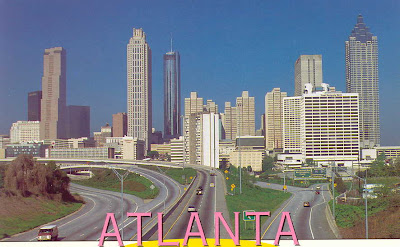
Cut off from each other by roaring freeways, bright lights and an enclave mentality, its neighborhoods tend to have distinct racial identities – broadly speaking, "white flight" was to the northern suburbs, while the southern districts are predominantly black. That said, the city is undeniably progressive, with little interest in lamenting a lost Southern past. Since voting in the nation's first black mayor, Maynard Jackson, in 1974, it has remained the most conspicuously black-run city in the US, and an estimated 200,000 black fami lies streamed in from states further north in the 1980s alone. The Olympics may not have been the triumph Atlanta so eagerly anticipated – even before the Centennial Park bombing tarnished the event itself, years of disruption and grandiose construction projects had left many Atlantans wondering whether the city had lost more than it gained – but with its ever-increasing international profile, cosmopolitan blend of cultures and hip local neighborhoods, the spirit and dynamism of modern Atlanta is a far cry indeed from its much-mythologized Deep South roots.
 Atlanta City industry – and consequently a major target for the Union army. In 1864 Sherman's army burned the city, an act immortalized in Gone with the Wind. Recovery after the war took just a few years: Atlanta was the archetype of the aggressive, urban, industrial "New South," furiously championed by "boosters" – newspaper owners, bankers, politicians and city leaders. Industrial giants who based themselves here included Coca-Cola, source of a string of philanthropic gifts to the city. Heavy black immigration to Atlanta increased its already considerable black population and led to the establishment of a thriving community centered around Auburn Avenue.
Very few of Atlanta's buildings predate 1915, and nothing at all survives from before 1868. Its characters, on the other hand – politicians and newspaper people – have changed little, and the "booster" tradition has continued to the present, peaking spectacularly when Atlanta won the right to host the 1996 Olympics. The bid to convince the world of the city's prosperity and sophistication was led by city leaders such as ex-mayor Andrew Young (the first Southern black congressman since Reconstruction, who became Carter's ambassador to the UN) and flamboyant former CNN magnate Ted Turner.
Today's Atlanta is at first glance a typical large American city. Its population has reached 3.5 million, and urban sprawl is such a problem that each citizen is obliged to travel an average of 34 miles per day by car – the highest figure in the country.

Cut off from each other by roaring freeways, bright lights and an enclave mentality, its neighborhoods tend to have distinct racial identities – broadly speaking, "white flight" was to the northern suburbs, while the southern districts are predominantly black. That said, the city is undeniably progressive, with little interest in lamenting a lost Southern past. Since voting in the nation's first black mayor, Maynard Jackson, in 1974, it has remained the most conspicuously black-run city in the US, and an estimated 200,000 black fami lies streamed in from states further north in the 1980s alone. The Olympics may not have been the triumph Atlanta so eagerly anticipated – even before the Centennial Park bombing tarnished the event itself, years of disruption and grandiose construction projects had left many Atlantans wondering whether the city had lost more than it gained – but with its ever-increasing international profile, cosmopolitan blend of cultures and hip local neighborhoods, the spirit and dynamism of modern Atlanta is a far cry indeed from its much-mythologized Deep South roots.
Amsterdam, Netherlands
Amsterdam is a compact, instantly likeable city. It's appealing to look at and pleasing to walk around, an intriguing mix of the parochial and the international; it also has a welcoming attitude towards visitors and a uniquely youthful orientation, shaped by the liberal counterculture of the last four decades. It's hard not to feel drawn by the buzz of open-air summer events, by the cheery intimacy of the city's clubs and bars, and by the Dutch facility with languages: just about everyone you meet in Amsterdam will be able to speak good-to-fluent English, on top of their own native tongue, and often more than a smattering of French and German too.

The city's layout is determined by a web of canals radiating out from an historical core to loop right round the centre. These planned, seventeenth-century extensions to the medieval town make for a uniquely elegant urban environment, with tall gabled houses reflected in their black-green waters. This is the city at its most beguiling, a world away from the traffic and noise of many other European city centres, and it has made Amsterdam one of the continent's most popular short-haul destinations. These charms are supplemented by a string of first-rate attractions, most notably the Anne Frankhuis, where the young Jewish diarist hid away during the German occupation of World War II, the Rijksmuseum, with its wonderful collection of Dutch paintings, including several of Rembrandt's finest works, and the peerless Vincent van Gogh Museum, with the world's largest collection of the artist's work.
However, it's Amsterdam's population and politics that constitute its most enduring characteristics. Celebrated during the 1960s and 1970s for its radical permissiveness, the city mellowed only marginally during the 1980s, and, despite the gentrification of the last twenty years, it retains a laid-back feel. That said, it is far from being as cosmopolitan a city as, say, London or Paris: despite the huge numbers of immigrants from the former colonies in Surinam and Indonesia, as well as Morocco and Turkey – to name but a few – almost all live and work outside the centre and can seem almost invisible to the casual visitor. Indeed, there is an ethnic and social homogeneity in the city centre that seems to run counter to everything you may have heard of Dutch integration.
The apparent contradiction embodies much of the spirit of Amsterdam. The city is world famous as a place where the possession and sale of cannabis are effectively legal – or at least decriminalized – and yet, for the most part, Amsterdammers themselves can't really be bothered with the stuff. And while Amsterdam is renowned for its tolerance towards all styles of behaviour and dress, a primmer, more correct-thinking big city, with a more mainstream dress sense, would be hard to find. Behind the cosy cafés and dreamy canals lurks the suspicion that Amsterdammers' hearts lie squarely in their wallets, and while newcomers might see the city as a liberal haven, locals can seem just as indifferent to this as well.

In recent years, a string of hardline city mayors have taken this conservatism on board and seem to have embarked on a generally successful – if often unspoken – policy of squashing Amsterdam's image as a counterculture icon and depicting it instead as a centre for business and international high finance. Almost all the inner-city squats – which once well-nigh defined local people-power – are gone or legalized, and coffeeshops have been forced to choose between selling dope or alcohol, and, if only for economic reasons, many have switched to the latter. Such shifts in attitude, combined with alterations to the cityscape, in the form of large-scale urban development on the outskirts and regeneration within, combine to create an unmistakeable feeling that Amsterdam and its people are busy reinventing themselves, writing off their hippyfied history to return to earlier, more stolid days.

Nevertheless, Amsterdam remains a casual and intimate place, and Amsterdammers themselves make much of their city and its attractions being gezellig, a rather overused Dutch word roughly corresponding to a combination of "cosy", "lived-in" and "warmly convivial". Nowhere is this more applicable than in the city's unparalleled selection of drinking places, whether you choose a traditional brown bar or one of a raft of newer, designer cafés, or grand cafés. The city boasts dozens of great restaurants too, with its Indonesian cuisine second-to-none, and is at the forefront of contemporary European film, dance, drama and music. The city has several top-rank jazz venues and the Concertgebouw concert hall is home to one of the world's leading orchestras. The club scene is restrained by the standard of other main cities, although the city's many gay bars and clubs partly justify Amsterdam's claim to be the "Gay Capital of Europe".
Subscribe to:
Posts (Atom)
Brazil
Brazil has an exotic variety of wild life thriving in spectacular natural settings. This journey takes you to a selection of these remark...

-
 Health insurance policies will often cover the cost of private medical treatments if the National Health Service in the United Kingdom (NHS...
-
 Travel insurance is insurance that is intended to cover medical expenses, financial (such as money invested in nonrefundable pre-payments),...
-
Brazil has an exotic variety of wild life thriving in spectacular natural settings. This journey takes you to a selection of these remark...
